
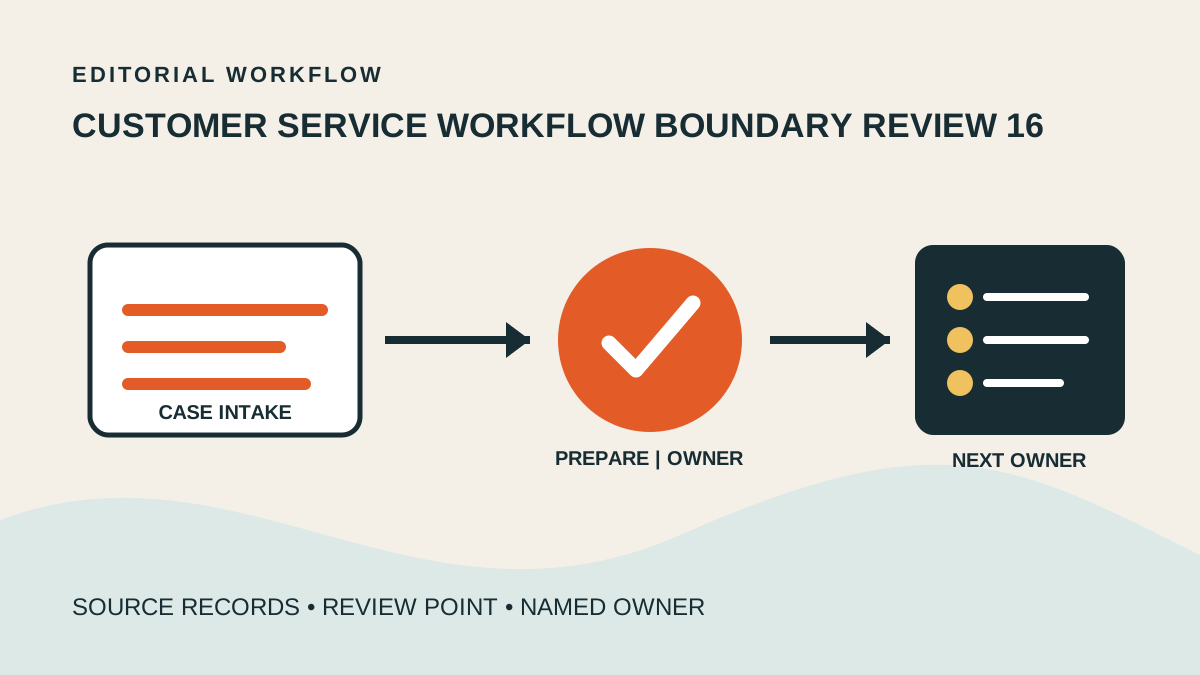
Conceptual, non-empirical finding
Workflow boundary review: This conceptual review asks where repeatable preparation ends and accountable judgment begins.
For customer service support, this is a study design and operating interpretation. It reports no measured result, person, business outcome, or performance claim.
Actual workflow records
Inspect records created by the operating workflow rather than hypothetical examples. For this service, the relevant record path is: Confirm the customer's identity and service location using the company's approved verification fields. Capture the caller's request in their own words and check for an existing customer case or open job before creating another record. Answer only from approved office information, then classify the case using written routine, priority, complaint, and emergency paths. Route the customer case with its contact history and supporting job references to the responsible team member. Send an approved acknowledgement and record the expected next owner without guaranteeing an outcome or timing.
The review set should retain the inputs used by the role. Provide approved service-area, hours, appointment, payment-method, and communication policies plus role-based access to customer and job history. The customer intake form should capture contact details, service location, caller's own description, related job if known, preferred response channel, and escalation category.
Sample and comparison method
Select actual workflow records from one defined queue and period. Include ordinary records and records returned for review rather than choosing only clean examples.
Compare each recorded action with the written role boundary, required source fields, approval point, and named owner. Record ambiguity as a design question, not as staff performance evidence.
Evidence to inspect
A customer case containing verified contact context, verbatim issue summary, linked job history, communication log, classification, and next owner.
An unresolved-case handoff grouped by safety alert, active-service complaint, scheduling request, billing question, and routine information request.
Review customer records for duplicate cases, accurate service location, source-linked notes, correct consent or channel preference, and a named next owner.
Audit escalated caller notes to confirm that urgent phrases were preserved rather than softened and that only approved customer wording was sent.
Exceptions and escalation
Immediately use the company's emergency path for customer reports of gas odor, smoke, fire, carbon monoxide alarm, electrical hazard, injury, or another stated immediate danger.
Route threats, legal or insurance statements, repeated complaints, refund demands, disputed work, abusive contact, and vulnerable-customer concerns to the designated customer service owner.
Bounded interpretation
The review can expose places where ownership or instructions need clarification. It cannot establish productivity, causation, compliance, or performance across the business.
The support role may document customer requests and provide approved office information; it may not diagnose, give safety or technical instructions, admit liability, promise refunds, or commit field resources.
Emergency direction, complaint resolution, credits, policy exceptions, legal responses, and technical advice remain with authorized personnel and emergency services where applicable.
Map the next controlled handoff
Bring one recurring workflow, its source records, and the person who owns exceptions.
Plan a free consultation