
Conceptual, non-empirical finding
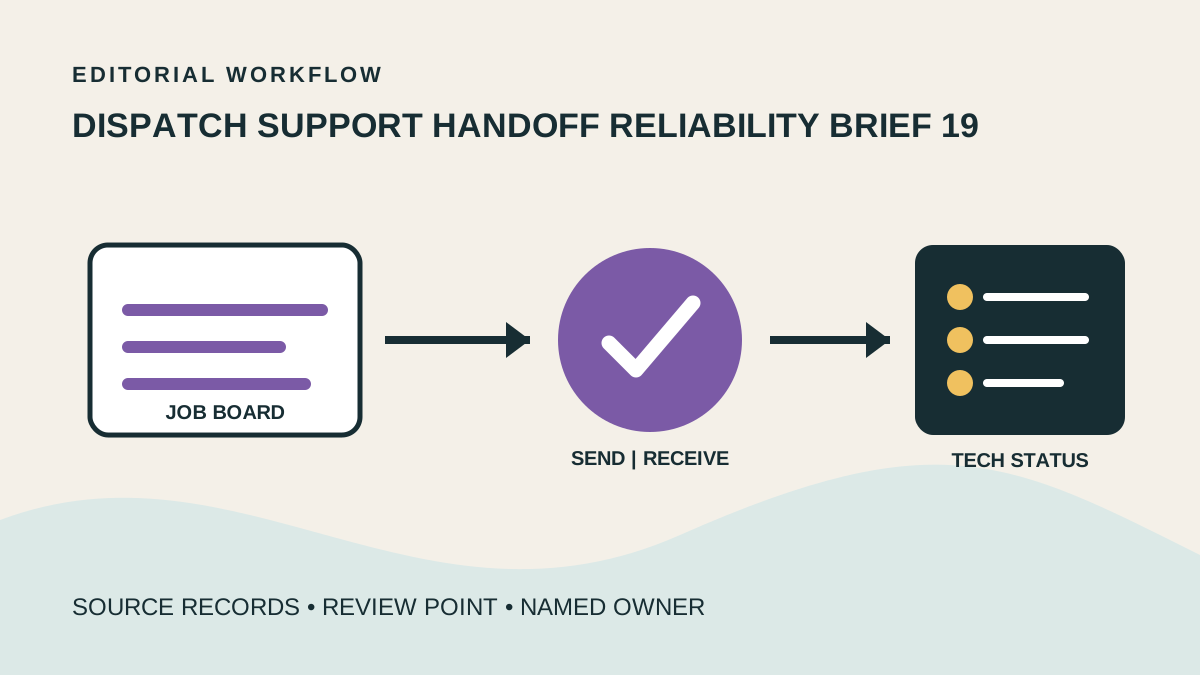
Handoff reliability brief: This conceptual brief examines whether a receiving owner can identify the record state, evidence, open question, and next action.
For dispatch support, this is a study design and operating interpretation. It reports no measured result, person, business outcome, or performance claim.
Actual workflow records
Inspect records created by the operating workflow rather than hypothetical examples. For this service, the relevant record path is: Open the active job board and reconcile technician acknowledgements with the recorded assignment. Check each job for address, contact, access, promised window, and approved priority fields before marking it ready. Record technician-provided en route, arrived, paused, and complete updates without interpreting field findings. Send only approved window notices, log the communication, and place conflicts in the dispatcher's review queue. Close the handoff with the current job status, source timestamp, next action, and named owner.
The review set should retain the inputs used by the role. Provide role-based access to the dispatch board, job records, technician status channel, service-area map, on-call roster, and approved arrival templates. Each job needs the service address, contact details, promised window, job type, equipment or access notes already supplied by the customer, and assigned priority.
Sample and comparison method
Select actual workflow records from one defined queue and period, including completed handoffs, open handoffs, and handoffs returned for clarification.
Compare the sending record with the receiving queue for matching identifiers, status, source time, next action, and owner. A mismatch is a review item and not evidence of an outcome.
Evidence to inspect
An updated technician board with source timestamps, customer contact history, and unresolved job conflicts visible.
A shift handoff listing waiting customers, jobs without acknowledgement, access constraints, and decisions needed from the dispatcher.
Compare every moved job against the original promised window and verify that the technician update came from the authorized channel.
Before shift handoff, check that no active job lacks a next owner and that customer notices match the approved dispatch template.
Exceptions and escalation
Route double bookings, unavailable technicians, out-of-area jobs, repeated no-contact attempts, and missed windows to the on-duty dispatcher with the job record attached.
Escalate any customer report involving gas odor, smoke, electrical hazard, medical risk, or immediate danger through the company's emergency path rather than placing it in the routine job queue.
Bounded interpretation
The brief can show where the handoff specification needs attention. It does not demonstrate reliability across other periods, teams, systems, or service lines.
The support role may maintain job records and send approved notices; it may not diagnose equipment, assign technical priority, direct technician work, or promise an arrival outside approved dispatch rules.
Schedule overrides, after-hours acceptance, safety instructions, and changes to field capacity remain with authorized dispatch or technical leadership.
Map the next controlled handoff
Bring one recurring workflow, its source records, and the person who owns exceptions.
Plan a free consultation