
Conceptual, non-empirical finding
Review consistency report: This conceptual report asks whether the same documented review rule is applied to comparable records.
For parts and warranty administration, this is a study design and operating interpretation. It reports no measured result, person, business outcome, or performance claim.
Actual workflow records
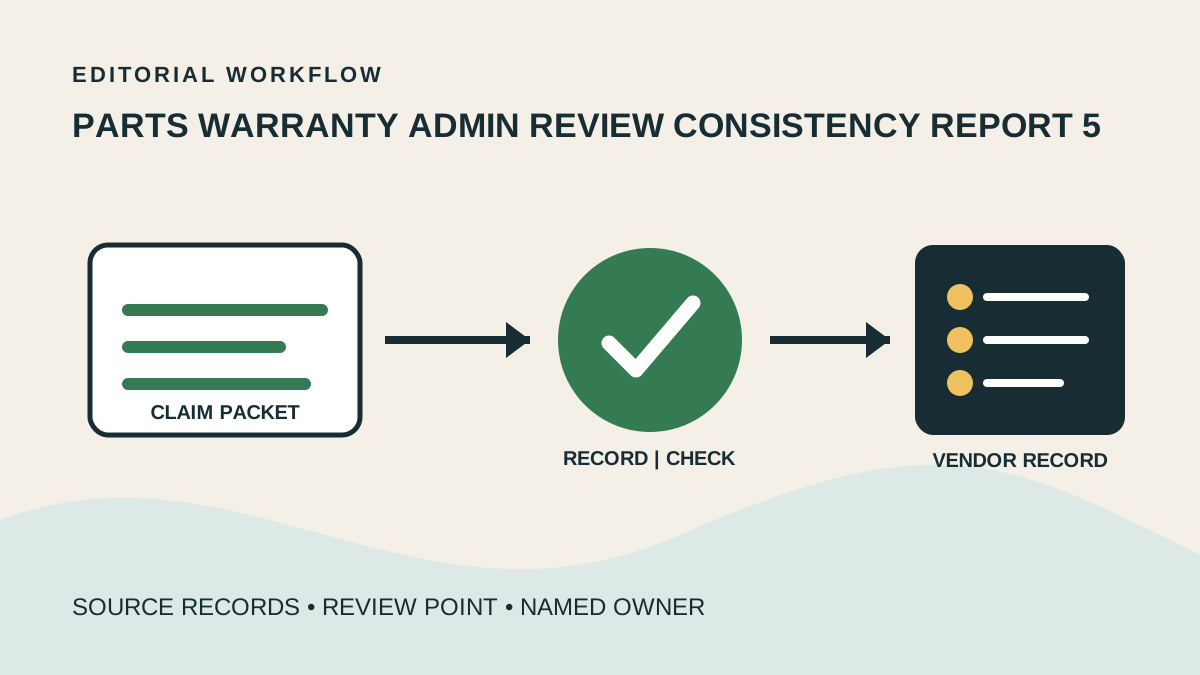
Inspect records created by the operating workflow rather than hypothetical examples. For this service, the relevant record path is: Open the parts or warranty request and match it to the service job, customer equipment record, and authorized technical finding. Check the claim packet for required model, serial, installation date, part reference, proof of purchase, photos, and labor documentation. Enter source-backed fields into the vendor claim or parts request and save a review copy before submission where approval is required. Record vendor acknowledgement, return authorization, shipment, credit, denial, or request for information exactly as received. Route technical, coverage, substitute-part, financial, and deadline exceptions to the named claim owner.
The review set should retain the inputs used by the role. Provide the service job, technician-supplied diagnosis, model and serial image, installation or purchase record, part number supplied by authorized staff, vendor portal requirements, and claim owner. Role-based access should permit claim preparation and status review but exclude authority to select parts, certify technical findings, approve coverage, or accept vendor terms.
Sample and comparison method
Select actual workflow records from one defined queue and period. Form comparison groups only where records share the same status, required evidence, and review rule.
Compare reviewer dispositions with the checklist and retained evidence. Send legitimate policy, technical, or financial differences to the accountable owner instead of forcing unlike records into one result.
Evidence to inspect
A review-ready claim packet with service-job link, model and serial evidence, authorized part reference, required attachments, and missing-item checklist.
A parts and warranty tracker showing vendor case number, request date, return deadline, shipment or credit status, next action, and claim owner.
Compare model, serial, and part identifiers character by character against their source images or authorized records before preparing the claim.
Check every warranty packet against the specific vendor checklist and retain submission confirmation, return tracking, and vendor correspondence in the claim record.
Exceptions and escalation
Pause a part or claim packet for unreadable labels, conflicting serial numbers, absent technical findings, missing purchase evidence, expired return windows, or mismatched job records.
Route claim denials, suspected duplicate claims, substitute-part proposals, coverage disputes, refrigerant or safety-related technical questions, and vendor credit discrepancies to authorized owners.
Bounded interpretation
The report can identify questions about checklist application in the selected records. It cannot grade reviewers, establish correctness, or support a broader performance conclusion.
The support role may assemble and track a warranty claim; it may not diagnose failure, select or substitute parts, certify coverage, alter technician findings, authorize returns, or post a vendor credit.
Technical conclusions stay with qualified HVAC personnel, coverage stays with the manufacturer or authorized claim owner, and financial posting stays with authorized accounting staff.
Map the next controlled handoff
Bring one recurring workflow, its source records, and the person who owns exceptions.
Plan a free consultation