
Who this role is for
This lane is for a dispatcher or service manager whose technician board is accurate only when one busy person keeps every change in memory.
It fits teams with written priority rules, defined service areas, approved customer messages, and an on-duty person who owns field and safety decisions.
The problem it addresses
A late technician update, an unrecorded access note, or two jobs promised for the same window can make the dispatch board unreliable.
Dispatch support keeps source-backed job status and customer communication together so the dispatcher can resolve capacity rather than reconstruct the day.
Scope of work
- Prepare dispatch records
- Update job statuses
- Coordinate approved notices
- Flag schedule conflicts
The exact scope is documented before launch. Work outside that scope is returned or escalated, not guessed.
Inputs and access
- Provide role-based access to the dispatch board, job records, technician status channel, service-area map, on-call roster, and approved arrival templates.
- Each job needs the service address, contact details, promised window, job type, equipment or access notes already supplied by the customer, and assigned priority.
Workflow and deliverables
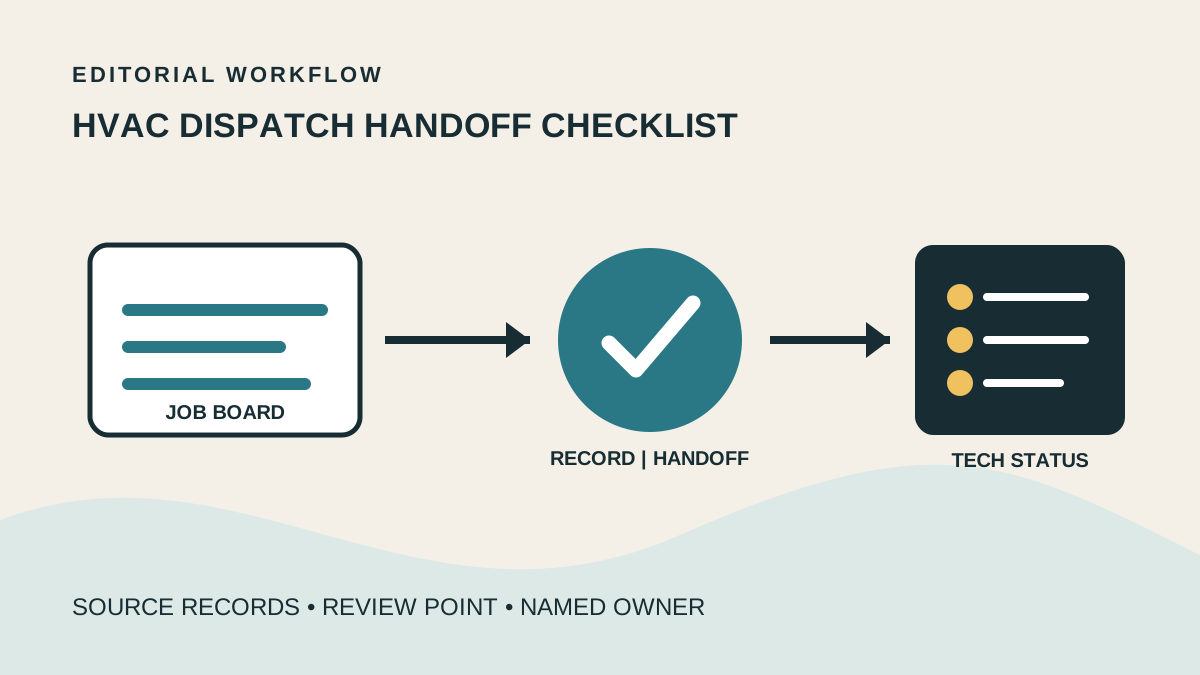
- Open the active job board and reconcile technician acknowledgements with the recorded assignment.
- Check each job for address, contact, access, promised window, and approved priority fields before marking it ready.
- Record technician-provided en route, arrived, paused, and complete updates without interpreting field findings.
- Send only approved window notices, log the communication, and place conflicts in the dispatcher's review queue.
- Close the handoff with the current job status, source timestamp, next action, and named owner.
Deliverables
- An updated technician board with source timestamps, customer contact history, and unresolved job conflicts visible.
- A shift handoff listing waiting customers, jobs without acknowledgement, access constraints, and decisions needed from the dispatcher.
Quality controls
- Compare every moved job against the original promised window and verify that the technician update came from the authorized channel.
- Before shift handoff, check that no active job lacks a next owner and that customer notices match the approved dispatch template.
Decision boundaries
Exception paths
- Route double bookings, unavailable technicians, out-of-area jobs, repeated no-contact attempts, and missed windows to the on-duty dispatcher with the job record attached.
- Escalate any customer report involving gas odor, smoke, electrical hazard, medical risk, or immediate danger through the company's emergency path rather than placing it in the routine job queue.
Reserved decisions
The support role may maintain job records and send approved notices; it may not diagnose equipment, assign technical priority, direct technician work, or promise an arrival outside approved dispatch rules.
Schedule overrides, after-hours acceptance, safety instructions, and changes to field capacity remain with authorized dispatch or technical leadership.
Common starting scenarios
- Start with the morning job-board check for one service area where technician acknowledgements are currently collected in chat.
- Another controlled start is the afternoon window-notice queue, with every job conflict returned to the dispatcher before any customer promise changes.
Frequently asked questions
Can dispatch support reassign a technician when a job runs long?
No. The assistant documents the technician update and shows the conflict, while the authorized dispatcher decides whether to reassign the job or change the customer window.
How are urgent dispatch calls handled?
The assistant follows the company's written urgent-call path, records the caller's words, and immediately alerts the designated dispatcher without diagnosing the equipment or giving safety instructions.
What proves that the dispatch board is current?
Each active job should show the source and time of the latest technician status, the last approved customer notice, the next action, and the person who owns it.
Related services
Start with a controlled handoff
Bring one recurring queue and the person who owns its decisions. We will help shape the support lane around your operating reality.
Plan a free consultation